|
The
Yamaha XT660R
- One of the industries most underrated Dual Sport Adventure
Motorcycles |

When
the Going gets Tuff...... |
XT660R
|
|
Design
& Appeal
The ruggered looks are equally matched by the
bikes ability to handle the rough terrain like a true
off road bike.
In its class of dual sport bikes, you can bet that few
owners actually do the bike any justice by sticking to
the tar road (No pun intended, cause it sticks wonderfully).
If you want a dualsport bike that can be pushed hard like
an enduro bike, but has the comfort and road handling
of a street commuter - this is the bike for you.
|
|
The
Yamaha XT660R
Having the XT660R under me for 680km was
definitely fantastic way to spend a weekend. The bike is without
doubt one of, if not THE most underrated Dualsport bike on the
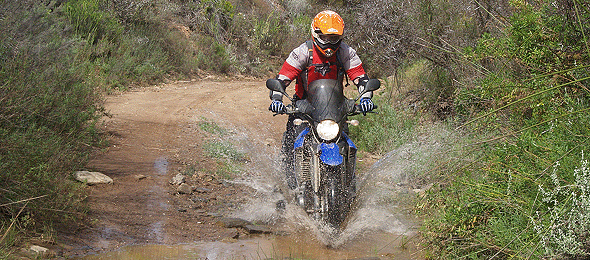
market. I was very impressed with the off road capability.
Craig Marshall - Rider |
Test
Ride Location
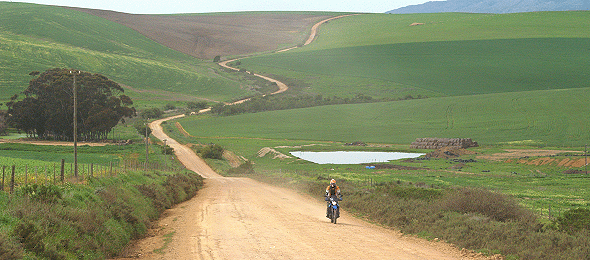
The Overberg Overnighter is a 680km
route over 2 days through the rolling hills and mountain
passes of the Western Cape Overberg.
Starting on the highlands trail in Grabouw and dissecting
the farms and winelands all the way to Cape Agulhas and
De Hoop Nature Reserve.
Day two takes a northern direction to the Malgas Pontoon
acss the Breede River and up through Suurbraak and the
fantastically scenic Tradouws Pass to Barrydale and joining
up with the R62 to Montagu. From Montagu to Robertson
and Le Chasseur farm lands to Theewaterskloof, then back
to Botriver via Van der Stels Pass. |
 |
|
|
|
|
 Light, robust, agile, A real pleasure
off road and on tar.
Light, robust, agile, A real pleasure
off road and on tar. |
 |
2012
Yamaha
XT660R - Specifications
|
| Engine
type |
Liquid-cooled,
4-stroke, single cylinder, 4-valve, SOHC |
| Displacement |
660
cc |
| Bore
x stroke |
100.0
x 84.0 mm |
| Performance |
35.3
kW (48 PS) @ 6,000 rpm |
| Max.
torque |
60.0
Nm (6.1 kg-m) @ 5,250 rpm |
| Compression
ratio |
10.0
: 1 |
| Starter/Battery |
Electric |
| Overall
Height |
1,230
mm |
| Fuel
System |
Fuel
injection |
| Ignition |
TCI |
| Primary
drive |
Chain |
| Cooling |
Liquid
Cooled |
| Clutch |
Wet,
multiple-disc coil spring |
| Gearbox |
Constant
mesh, 5-speed |
| Frame |
Steel
tube, diamond shaped |
| Front
suspension |
Telescopic
forks |
| Rear
suspension |
Swingarm
(monocross) |
| Suspension
travel front/rear |
225
mm / 200mm |
| Front
brake |
Single
disc, Ø 298 mm |
| Rear
brake |
Single
disc, Ø 245 mm |
| Tyres,
front/rear |
90/90-21
M/C / 130/80-17 M/C |
| Trail |
107
mm |
| Wheel
base |
1,505
mm |
| Seat
height |
875
mm |
| Tank
capacity |
15L |
Wet
Weight (With fuel)
|
181
kg |
|
|
 |
|
Fuel
Economy:
It’s claimed that the bike can do an average of 23km
per litre, I did 190km and the petrol reserve light did
not come on, going on the given stats it would be safe to
say that with a 15 Litre tank you should get 345km. But
that’s only if you are cruising along the tarmac conservatively
between 80 - 100km/h. Get of the dirt road and pull a few
wheelies and drift the corners, and you may see 18km per
Litre before the reserve light comes on. The digital “F-Trip”
meter will initiate and start counting….. Reserve
is 5 litres so you should do another 60-70km if you ride
slow.
The standard fuel injection can be improved with a little
programming. Just press and hold both dash buttons as you
turn on the ignition and the display will read "diag"
after about 6 seconds. Then press the select button once
for "co", then press and hold both buttons for
"co1" and then again for the co1 number (probably
about 10 as standard). Then press select to increase the
number to about 15-20. Turn off the ignition to store the
new setting. Repeat the whole process to try each number
15-20 and see what you like best.
Seat Comfort:
Seat Comfort is always a debatable issue, if you’re
like me and stand up for 90% of all off road riding, then
it’s never a big issue. But I did find the seat relatively
comfortable remaining in the seat for over 100km along the
R62 tarmac. I never once felt the need to stand up and let
the blood circulate. Unfortunately Yamaha do not bring in
any other options compatible for the bike. So if you have
a soft butt and seat comfort is the reason behind buying
a certain bike, then I guess you gonna have to sit on it
and find out.
Weight:
It’s rated a 181kg with fuel however if you need to
suddenly shove the bike over and avoid a nasty pothole,
it reacts very quickly and it a pleasure to move around
in tight spots when you need to execute a 3 point turn on
a narrow path. Most riders will be able to pick the bike
up if dropped. In soft sand even with the road bias tyres,
the bike skipped across the surface showing little tendency
to snake or plough in.
Wind Protection:
The stock standard XT660R
fairing is too small, so you will need to add the after
market wind shield from Yamaha (As seen on the Right), and
then if you can add an extension of 6cm you will be able
to sit upright and not have the wind buffer your helmet.
As it stands (As seen on the Right) with the bigger wind
shield, you still get buffeting unless you hunch below the
vortex. Of course body height is a factor to consider
Vibration:
Yes it does vibrate, so does anything with an engine. Jokes
aside, being a single cylinder, the XT660R
is not vibration free, but has much less than some of its
competitors. At speeds up to 115km/h it’s not noticeable,
between 140km/h and 160km/h you know you’re not on
a V-Twin 1200 cruiser.
Off Road Handling:
This is where I was most impressed. I have spent
many years on Moto-X style bikes and this was one of the
first Dualsport bikes that I have ridden that handles like
a 650 Enduro bike. That’s not to say it will take
the chequered flag, but for a Dualsport bike, it’s
extremely nimble in the dirt and will out perform many similar
bikes in the 650cc and 700cc range.
The bike has the power to wheelie in 3rd gear if traction
allows, although the gearing has been designed for road
usage – if you were to fit a bigger rear sprocket
and knobbly tyres the XT660R would be in
a class of its own.
Road Handling:
The 5 speed gear box has been selected for predominately
rod usage, but that is easily changed with a bigger back
sprocket to give more torque. Its 60nm of torque are more
than adequate both on road and off road. There were times
I felt like a sixth gear would be nice, but it’s rare
to find a 6 speed in the 650cc single cylinders class. The
XT660R sticks to the tar and is wonderfully
responsive in corners, some of the characteristics inherent
in the XT660X (Motard) version. The braking
could do with a little beefing up as in the XT660Z
Tenere with Twin front Discs. |
 |
Conclusion:
To say the lease, the Yamaha XT660R
has what it takes to be the leader in the 650cc Dualsport
motorcycle market. The bike will suit most riders, not
only from a price perspective, from commuters around cities
and the occasional dirt road trip – to the hard
core adventurer who wants to cut a straight line through
Africa’s toughest terrain. Maybe the XT660R
is not the bike to do 12 000km on tarmac, but then buy
a cruiser and wear leather if that’s how you ride.
This bike was designed for adventure, and it certainly
can deliver. You will need to fit a few extras like the
full size wind shield, a bash plate to protect the vulnerable
exhausts and perhaps a better selection of off road tyres.
Add a set of Panniers and you’re in the Adventure
Motorcycling business.
With the late arrival of the new XT660Z
Tenere and XT1200Z
Super Tenere, Yamaha may just have
the three best rated Dualsport bikes under one roof. We
know that the market is flooded with much more powerful
brands, but when it comes down to overall capability,
retail price, availability of parts, cost of services
and frequency of services (10 000km) less if you work
her hard – the Yamaha XT660R
will surprise any one who takes her out for a ride, and
I don’t mean a 5 min spin around the block.
The XT660R
and XT660Z
Tenere
are now available for demo rides at selected Yamaha dealers.
Be sure to test the XT660R
before just buying a bike like the rest of the sheep. |
|
|